
Corporate growth hinges on a company’s ability to innovate effectively. This involves not just developing new products or services, but also fundamentally reimagining business models and processes. Successfully navigating this path requires a deep understanding of various innovation strategies, a robust implementation plan, and a commitment to measuring and adapting based on results. This exploration delves into the multifaceted nature of corporate growth through innovation, examining key strategies, challenges, and success stories.
From identifying promising innovation opportunities within existing structures to cultivating a culture that fosters creativity and risk-taking, the journey towards sustained growth demands a strategic and holistic approach. We’ll explore how effective training programs can empower employees to contribute meaningfully to innovation initiatives, and how to overcome common barriers such as risk aversion and internal resistance. Ultimately, the aim is to illustrate how a focused innovation strategy can propel a company towards significant and lasting growth.
Defining Corporate Growth Through Innovation
Corporate growth fueled by innovation is the expansion of a company’s market share, revenue, and overall value driven by the successful introduction and adoption of new products, services, processes, or business models. This growth isn’t solely reliant on incremental improvements; it thrives on the creation and implementation of novel ideas that reshape the competitive landscape.The key elements contributing to this type of growth include a strong innovation culture within the organization, adequate resources allocated to research and development, effective processes for identifying and evaluating new opportunities, a skilled workforce capable of executing innovative projects, and a robust marketing and sales strategy to bring innovative offerings to market.
Furthermore, a willingness to embrace calculated risk and adapt to market changes is crucial.
Incremental versus Disruptive Innovation
Incremental innovation involves making small, iterative improvements to existing products, services, or processes. Think of a smartphone manufacturer releasing a new model with a slightly better camera or a faster processor – this is incremental innovation. It builds upon what already exists, often leading to steady, predictable growth. In contrast, disruptive innovation introduces a completely new product or service that significantly alters the existing market.
This might involve creating a new market segment or displacing established players. A classic example is the introduction of the iPhone, which disrupted the existing mobile phone market and redefined how people interacted with technology. Disruptive innovation, while riskier, offers the potential for exponential growth but often requires a more significant investment and longer time horizon.
Innovation Strategies and Their Impact on Corporate Growth
The approach a company takes to innovation significantly impacts its growth trajectory. Different strategies offer various advantages and disadvantages.
| Innovation Strategy | Description | Impact on Corporate Growth | Example |
|---|---|---|---|
| Closed Innovation | R&D conducted internally, relying solely on the company’s resources and expertise. | Potentially slower growth due to limited perspectives and resources, but greater control over intellectual property. | A pharmaceutical company developing a new drug entirely within its own labs. |
| Open Innovation | Collaboration with external partners, including universities, startups, and other companies, to leverage external knowledge and resources. | Faster growth potential due to access to diverse perspectives and technologies, but requires effective management of collaborations and intellectual property. | A tech company partnering with a university research lab to develop a new AI algorithm. |
| Crowdsourcing | Leveraging the collective intelligence of a large group of people to generate ideas and solutions. | Can lead to rapid innovation and cost savings, but requires careful management and quality control. | A company using a platform to solicit design ideas for a new product from its customer base. |
| Corporate Venturing | Investing in or acquiring external startups to access new technologies or business models. | Provides access to cutting-edge innovation and potentially new market segments, but carries investment risk. | A large automotive company investing in a promising electric vehicle startup. |
Identifying Innovation Opportunities
Identifying and capitalizing on innovation opportunities is crucial for sustained corporate growth. This involves a systematic process of scanning the environment, analyzing internal capabilities, and prioritizing initiatives that align with strategic goals and offer the highest potential for return. A robust innovation strategy requires a proactive approach, moving beyond reactive problem-solving to actively seek out new avenues for growth and competitive advantage.Successful innovation initiatives often leverage existing resources and expertise in creative ways, while also incorporating external perspectives and technologies.
This necessitates a culture that encourages experimentation, embraces failure as a learning opportunity, and rewards creative risk-taking.
Examples of Successful Corporate Innovation Initiatives
Several successful corporate innovation initiatives demonstrate the transformative power of strategic innovation. Netflix’s transition from DVD rentals to a streaming service revolutionized the entertainment industry, highlighting the potential for disruptive innovation to reshape entire markets. Similarly, Amazon’s expansion into cloud computing (AWS) leveraged its existing infrastructure and expertise to create a highly profitable new business line. In the manufacturing sector, companies like Tesla have successfully integrated innovative manufacturing processes and supply chain management to achieve significant efficiencies and scale.
These examples underscore the importance of identifying and pursuing opportunities that leverage existing strengths while also exploring new frontiers.
Potential Areas for Innovation within a Hypothetical Large Corporation
Consider a large manufacturing corporation specializing in consumer electronics. Potential areas for innovation could include:
- Sustainable Manufacturing Processes: Implementing environmentally friendly materials and reducing waste through circular economy principles.
- Smart Products and IoT Integration: Embedding sensors and connectivity into products to gather data and offer enhanced user experiences.
- Personalized Manufacturing: Utilizing advanced technologies like 3D printing to customize products to individual customer needs.
- AI-Powered Supply Chain Optimization: Leveraging artificial intelligence to improve forecasting, inventory management, and logistics.
- New Business Models: Exploring subscription services or product-as-a-service models to generate recurring revenue streams.
For a large technology corporation, innovation opportunities might focus on:
- Artificial Intelligence Applications: Developing new AI-powered solutions for various industries.
- Cybersecurity Enhancements: Creating more robust and proactive cybersecurity measures.
- Quantum Computing Research: Investing in research and development of quantum computing technologies.
- Blockchain Technology Integration: Exploring applications of blockchain for secure data management and transactions.
- Edge Computing Infrastructure: Developing and deploying edge computing solutions for faster data processing and reduced latency.
In the retail sector, a large corporation could focus on:
- Omnichannel Retail Experiences: Seamlessly integrating online and offline shopping experiences.
- Personalized Marketing and Recommendations: Utilizing data analytics to provide targeted offers and recommendations.
- Augmented and Virtual Reality Applications: Enhancing the shopping experience through immersive technologies.
- Sustainable Packaging and Logistics: Reducing environmental impact through eco-friendly packaging and delivery methods.
- AI-Powered Customer Service: Implementing AI-powered chatbots and virtual assistants to improve customer support.
Challenges in Identifying and Prioritizing Innovation Opportunities
Identifying and prioritizing innovation opportunities presents several challenges. Resource constraints, including budget limitations and talent shortages, often restrict the number of initiatives a corporation can pursue simultaneously. Internal resistance to change and a lack of cross-functional collaboration can also hinder innovation efforts. Furthermore, accurately assessing the market potential and competitive landscape for new ideas requires careful analysis and forecasting, which can be complex and uncertain.
Finally, effectively managing the risks associated with new ventures is critical to minimize potential losses and maximize the likelihood of success.
Process of Identifying and Evaluating Innovation Opportunities
The following flowchart illustrates a process for identifying and evaluating innovation opportunities:[Imagine a flowchart here. The flowchart would start with “Idea Generation” branching into “Internal Sources” (e.g., employee suggestions, R&D) and “External Sources” (e.g., market research, competitor analysis, customer feedback). These would feed into “Idea Screening” which filters ideas based on criteria like feasibility, market potential, and alignment with strategic goals.
Successful ideas proceed to “Concept Development” where detailed business plans are created. This leads to “Prototype Development and Testing,” followed by “Market Launch and Commercialization.” At each stage, there’s a decision point to continue or discontinue the project based on the results of the previous stage. Feedback loops are incorporated throughout the process.]
Implementing Innovative Strategies
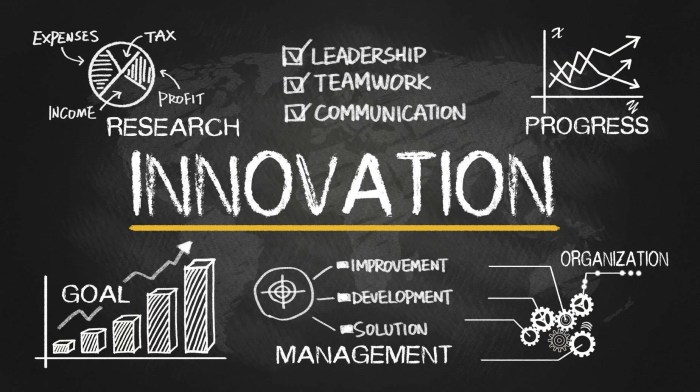
Successfully integrating innovation into a corporate structure requires a well-defined strategy, a supportive culture, and effective project management. This involves more than simply generating new ideas; it necessitates a systematic approach to development, implementation, and ongoing evaluation. The process is iterative, requiring constant adaptation and refinement based on market feedback and internal learnings.Developing and implementing an innovation strategy requires a phased approach.
First, a clear vision and objectives must be established, aligning innovation efforts with overall business goals. This involves identifying specific areas for innovation, allocating resources effectively, and defining key performance indicators (KPIs) for measuring success. Next, the strategy should be communicated clearly to all stakeholders, ensuring buy-in and collaboration across departments. Finally, the chosen strategy should be implemented, monitored, and adapted as needed throughout the process.
Regular review and adjustments are crucial for optimal results.
The Importance of a Strong Innovation Culture
A strong innovation culture is fundamental to the success of any innovation strategy. It fosters an environment where experimentation is encouraged, failures are viewed as learning opportunities, and employees feel empowered to contribute creative ideas. This culture is characterized by open communication, collaboration, and a willingness to embrace change. Companies with a robust innovation culture often demonstrate higher levels of employee engagement, faster time-to-market for new products and services, and improved overall financial performance.
For example, Google’s renowned “20% time” policy, allowing employees to dedicate a portion of their workweek to personal projects, has led to the development of groundbreaking products like Gmail.
Comparing Agile and Waterfall Innovation Project Management Approaches
Two common approaches to managing innovation projects are Agile and Waterfall. The Waterfall methodology follows a linear, sequential process, with each phase completed before moving to the next. This approach is well-suited for projects with clearly defined requirements and minimal anticipated changes. In contrast, Agile utilizes an iterative and incremental approach, emphasizing flexibility and adaptation throughout the project lifecycle.
Agile methodologies, such as Scrum, are better suited for projects with evolving requirements or a high degree of uncertainty. Choosing the appropriate methodology depends on the specific project’s nature, complexity, and risk tolerance. For instance, developing a new software application might benefit from an Agile approach, while implementing a new manufacturing process might be better suited to a Waterfall approach.
Key Performance Indicators (KPIs) for Innovation Initiatives
Tracking the success of innovation initiatives requires the use of relevant KPIs. These metrics provide insights into the effectiveness of the innovation strategy and allow for timely adjustments. A balanced scorecard approach, incorporating both financial and non-financial metrics, is recommended.
- Number of new product/service launches: Measures the output of the innovation process.
- Return on investment (ROI) of innovation projects: A crucial financial metric indicating profitability.
- Customer satisfaction with new offerings: Reflects market acceptance and product-market fit.
- Time to market for new products/services: Indicates efficiency and speed of innovation.
- Employee engagement in innovation activities: Measures the level of participation and enthusiasm.
- Number of patents filed/granted: Reflects the generation of intellectual property.
- Percentage of revenue from innovative products/services: Shows the contribution of innovation to overall revenue.
Measuring and Evaluating Innovation Success
Successfully measuring the impact of innovation initiatives is crucial for justifying investments and informing future strategies. A robust evaluation framework allows companies to understand what works, what doesn’t, and how to optimize their innovation processes for maximum return. This involves both quantitative and qualitative assessments, recognizing the complexities of attributing specific outcomes to innovation efforts.Measuring the return on investment (ROI) of innovation projects can be challenging, particularly in the short term.
Many innovations yield benefits that are intangible or accrue over extended periods. However, a multifaceted approach incorporating various metrics can provide a more complete picture.
Return on Investment (ROI) Measurement Methods
Several methods exist for calculating the ROI of innovation projects. These methods often need to be adapted to the specific nature of the innovation and the available data. A simple, but often incomplete, approach is to compare the cost of the innovation project with the increase in revenue generated. More sophisticated methods might involve discounted cash flow analysis, which accounts for the time value of money, or scenario planning, which assesses potential ROI under different market conditions.
For example, a company launching a new software product could track customer acquisition costs, lifetime value, and market share growth to assess its financial return. A pharmaceutical company developing a new drug might use a more complex model factoring in clinical trial costs, regulatory approval timelines, and projected sales figures.
Challenges in Quantifying Long-Term Impact
Quantifying the impact of innovation on long-term corporate growth presents significant challenges. Many innovations contribute to competitive advantage, improved brand reputation, and enhanced employee morale—factors difficult to translate directly into financial metrics. For instance, the development of a new, more efficient manufacturing process might lead to significant cost savings over several years, but the initial investment may not show a substantial return in the first year.
Furthermore, the effects of innovation can be indirect and spread across various aspects of the business, making attribution difficult. For example, a company’s investment in employee training and development might lead to improved productivity and innovation down the line, but directly linking this investment to specific financial gains is challenging.
Framework for Evaluating Innovation Strategy Success
A comprehensive framework for evaluating innovation strategy success should incorporate both leading and lagging indicators. Leading indicators provide insights into the effectiveness of the innovation process itself, while lagging indicators measure the ultimate outcomes. The framework should assess the efficiency of resource allocation, the effectiveness of the innovation process, the quality of innovation outputs, and the impact on business goals.
This could include metrics such as the number of successful product launches, the speed of innovation cycles, employee engagement in innovation activities, and the impact on market share or customer satisfaction. Regular review and adjustment of the framework are essential to adapt to changing business conditions and learn from past experiences.
Examples of Qualitative and Quantitative Metrics
Quantitative metrics include financial measures like ROI, revenue growth attributable to innovation, cost savings, market share gains, and customer acquisition costs. Qualitative metrics encompass aspects such as employee satisfaction, brand perception, competitive advantage, and customer feedback. For example, a successful innovation might be reflected in higher customer satisfaction scores, positive media coverage, and increased employee morale alongside measurable financial gains.
Conversely, a less successful innovation might be characterized by low customer adoption rates, negative reviews, and decreased employee motivation, regardless of the initial investment. A balanced scorecard approach, incorporating both types of metrics, provides a holistic view of innovation success.
Corporate Growth & Corporate Training
Effective corporate training programs are crucial for fostering innovation and driving sustainable growth. They bridge the gap between strategic goals and employee capabilities, equipping individuals with the skills and knowledge necessary to contribute meaningfully to innovation initiatives. By investing in training, companies not only enhance individual performance but also cultivate a culture of continuous learning and improvement, which is fundamental to long-term success.Investing in employee development directly translates into increased innovation capacity.
Upskilling and reskilling initiatives empower employees to adapt to evolving market demands, embrace new technologies, and develop innovative solutions. This proactive approach ensures that the workforce possesses the relevant competencies to execute innovation strategies effectively, minimizing resistance to change and maximizing the return on innovation investments.
The Role of Upskilling and Reskilling in Innovation
Upskilling focuses on enhancing existing skills to improve current job performance, while reskilling equips employees with entirely new skills for different roles or responsibilities. Both are vital for driving innovation. Upskilling might involve training employees on new software or methodologies relevant to their current projects, while reskilling could involve retraining employees in data analytics to support a new data-driven strategy.
This dual approach ensures the organization remains agile and adaptable, ready to tackle emerging challenges and opportunities. A well-designed upskilling and reskilling program should be aligned with the company’s innovation strategy, identifying skill gaps and addressing them proactively.
Examples of Successful Training Programs
Several companies have demonstrated the direct link between corporate training and innovation success. For example, Google’s renowned “Innovation Time Off” program, which allows employees to dedicate 20% of their work time to personal projects, has led to the development of numerous innovative products and services, including Gmail and AdSense. This program, while not strictly a formal training program, fosters a culture of experimentation and innovation through dedicated time and resources.
Similarly, companies like Salesforce invest heavily in training programs focused on emerging technologies like AI and cloud computing, directly contributing to their innovative product development and market leadership. These programs often incorporate hands-on workshops, mentorship opportunities, and collaborative projects to maximize learning and impact.
Integrating Corporate Training into an Innovation Strategy
A comprehensive plan is needed to effectively integrate corporate training into a broader innovation strategy. This plan should be structured as follows:
- Needs Assessment: Identify skill gaps and training needs related to specific innovation goals. This involves analyzing current employee competencies, reviewing the innovation strategy, and identifying future skill requirements.
- Curriculum Development: Design training programs that directly address the identified skill gaps. These programs should incorporate diverse learning methods, including online courses, workshops, mentorship programs, and simulations, catering to different learning styles.
- Program Implementation: Roll out the training programs effectively, ensuring accessibility and engagement. This involves utilizing various delivery methods, providing adequate resources, and tracking participation and progress.
- Evaluation and Improvement: Continuously evaluate the effectiveness of the training programs through metrics such as employee performance, innovation output, and employee satisfaction. Use this data to refine the curriculum and improve future training initiatives.
- Integration with Performance Management: Link training completion and performance improvements to reward and recognition systems, reinforcing the value of continuous learning and its contribution to innovation.
This structured approach ensures that training efforts are aligned with the company’s overall innovation objectives, maximizing the impact on corporate growth.
Overcoming Barriers to Innovation
Innovation, while crucial for corporate growth, often faces significant hurdles within organizations. These barriers can stem from various sources, hindering the successful implementation of new ideas and technologies. Addressing these challenges requires a multifaceted approach involving strategic planning, resource allocation, and a fundamental shift in corporate culture.
Common barriers to innovation frequently include risk aversion, limited resources, internal resistance to change, and a lack of clear communication and collaboration. These obstacles can significantly impede the progress of innovative projects, leading to missed opportunities and ultimately, stifled growth. Overcoming these challenges necessitates a proactive and comprehensive strategy.
Risk Aversion and its Mitigation
Risk aversion is a natural human tendency, but in the context of corporate innovation, it can be paralyzing. Companies often prioritize short-term stability over long-term growth potential, leading to a reluctance to invest in potentially high-risk, high-reward ventures. Strategies to overcome this involve creating a culture that embraces calculated risk-taking, implementing robust risk management frameworks to mitigate potential downsides, and celebrating both successes and “intelligent failures” – those that provide valuable learning experiences despite not yielding immediate success.
This fosters a more experimental environment where innovation can flourish. For example, Google’s “20% time” initiative, which allows employees to dedicate a portion of their workweek to personal projects, has resulted in groundbreaking innovations like Gmail.
Resource Constraints and Resource Allocation
Innovation often requires significant investment in time, money, and human capital. Limited resources, whether financial, technological, or human, can severely constrain a company’s ability to pursue innovative projects. Effective strategies include prioritizing innovation initiatives based on strategic alignment and potential return on investment (ROI), securing external funding through partnerships or venture capital, and optimizing resource allocation through efficient project management techniques.
A clear and well-defined budget specifically dedicated to innovation can demonstrate commitment and ensure the necessary resources are available.
Internal Resistance to Change and Fostering Collaboration
Implementing innovative strategies frequently encounters resistance from employees who are comfortable with existing processes and may fear the disruption caused by change. Overcoming this resistance requires open communication, employee involvement in the innovation process, and effective change management strategies. Providing comprehensive training and support to employees, highlighting the benefits of innovation, and recognizing and rewarding contributions can significantly reduce resistance and foster a collaborative environment.
Companies like Spotify have successfully cultivated a culture of innovation by empowering employees at all levels to contribute ideas and participate in the development process.
Leadership’s Role in Cultivating an Innovative Environment
Leadership plays a pivotal role in fostering a culture that embraces innovation. Leaders must champion innovation initiatives, allocate resources effectively, and create a safe space for employees to propose new ideas without fear of retribution. They need to actively communicate the importance of innovation to the entire organization, establish clear goals and metrics for innovation success, and provide ongoing support and mentorship to innovation teams.
Leaders who actively listen to employees, solicit feedback, and demonstrate a genuine commitment to innovation are crucial for building a thriving innovation ecosystem. Examples of leaders who effectively fostered innovation include Steve Jobs at Apple and Jeff Bezos at Amazon, who both cultivated cultures known for their risk-taking and relentless pursuit of new ideas.
Case Studies
Successful corporate growth often hinges on a company’s ability to innovate and adapt to changing market demands. Examining real-world examples provides valuable insights into the strategies, challenges, and outcomes associated with innovation-driven growth. The following case studies illustrate how different companies leveraged innovation to achieve significant expansion and market leadership.
Apple’s Transformation Through Product Innovation
Apple’s resurgence in the late 1990s and beyond is a prime example of how innovative product design and user experience can fuel exponential growth. After a period of relative decline, Apple’s introduction of the iMac in 1998 marked a turning point. This all-in-one computer, with its sleek design and user-friendly interface, redefined the personal computer market. Subsequent innovations like the iPod, iPhone, and iPad solidified Apple’s position as a technology leader, driving substantial revenue growth and creating a highly loyal customer base.
The iMac’s success wasn’t solely due to its innovative design; it also addressed a market need for simpler, more intuitive computing. Apple faced challenges in scaling production to meet the unexpectedly high demand for the iMac, but the company effectively addressed these issues through strategic partnerships and efficient manufacturing processes. The outcome was a dramatic increase in market share and profitability, transforming Apple from a struggling company into a global tech giant.
Netflix’s Pivot to Streaming and Original Content
Netflix’s transition from a DVD rental service to a global streaming giant showcases the power of strategic innovation in response to disruptive market forces. Facing the rise of digital media and competition from other streaming services, Netflix boldly invested in its streaming platform and original content creation. This pivot required significant capital investment and a shift in its business model, but it ultimately proved highly successful.
The challenges included developing a robust streaming infrastructure capable of handling millions of simultaneous users, securing licensing agreements for popular content, and creating high-quality original programming that would attract and retain subscribers. The outcome was a dramatic increase in subscribers, global expansion, and the establishment of Netflix as a major player in the entertainment industry. Their original content strategy, featuring shows like “House of Cards” and “Stranger Things,” differentiated Netflix from its competitors and significantly boosted its brand recognition.
Amazon’s Expansion Through E-commerce and Cloud Computing
Amazon’s success is a testament to the power of disruptive innovation across multiple sectors. Starting as an online bookstore, Amazon rapidly expanded its e-commerce platform, leveraging technology to optimize logistics, customer service, and personalized recommendations. More recently, Amazon Web Services (AWS) has become a dominant force in cloud computing, demonstrating the company’s ability to innovate and create entirely new markets.
Amazon faced significant challenges in building its logistics infrastructure, managing complex supply chains, and competing with established retailers. The company’s investment in technology and data analytics was crucial in overcoming these challenges. The outcome has been extraordinary growth across e-commerce, cloud computing, and other related businesses, establishing Amazon as one of the world’s most valuable companies. AWS, in particular, represents a remarkable example of innovation creating a new revenue stream and establishing market dominance in a rapidly expanding sector.
Visualizing Innovation’s Impact
Data visualization is crucial for understanding the complex relationship between innovation and corporate growth. By visually representing the impact of implemented innovation strategies, companies can gain clearer insights into their progress, identify areas for improvement, and effectively communicate their achievements to stakeholders. A well-designed visualization can transform abstract concepts into readily understandable narratives, showcasing the tangible benefits of innovation investment.A hypothetical scenario illustrates this: imagine a software company, “InnoSoft,” struggling with stagnant growth.
Their market share is plateauing, and customer acquisition costs are rising. They decide to invest heavily in AI-powered customer service and a new, intuitive user interface. Post-implementation, InnoSoft could visualize its growth trajectory using a line graph. The x-axis would represent time (in months or quarters), while the y-axis would depict key performance indicators (KPIs) such as revenue, customer acquisition cost, and customer satisfaction scores.
Before the innovation implementation, the line representing revenue would show a relatively flat trajectory. After implementing the AI and new UI, however, the line would sharply incline, demonstrating a clear correlation between the innovative strategies and increased revenue. Simultaneously, the line representing customer acquisition cost would show a downward trend, reflecting the efficiency gains from the AI-powered customer service.
The customer satisfaction line would also rise, demonstrating improved user experience due to the new interface. This combined visual representation provides a compelling narrative of how innovation directly translated into improved business performance.
Growth Trajectory Visualization
The visualization could further be enhanced by incorporating different colored lines to represent each KPI, making it easy to compare their performance over time. A key would clearly label each line, ensuring clarity. The graph’s title could be something like “InnoSoft’s Growth Trajectory Post-Innovation Implementation,” and the axes should be clearly labeled with units (e.g., revenue in millions of dollars, customer acquisition cost in dollars, customer satisfaction score on a scale of 1-10).
Furthermore, the graph could include markers indicating the specific point in time when the innovation strategies were implemented, making the impact even more apparent. This detailed visualization would allow InnoSoft to easily track progress, identify potential bottlenecks, and make data-driven decisions to further optimize their growth strategy. The visualization would also be a powerful tool for communicating their success to investors and other stakeholders.
For example, a presentation slide showing this graph would instantly communicate the positive impact of the innovation initiative.
In conclusion, corporate growth through innovation is not a singular event but a continuous process requiring strategic planning, cultural transformation, and a commitment to measuring and adapting. By understanding the various innovation strategies, identifying and prioritizing opportunities effectively, and fostering a culture that embraces change, companies can unlock significant growth potential. The case studies presented highlight the transformative power of innovation when coupled with a well-defined strategy and a commitment to continuous improvement.
The journey requires dedication, but the rewards – in terms of market leadership, competitive advantage, and sustained growth – are substantial.
Top FAQs
What are some common mistakes companies make when pursuing innovation?
Common mistakes include underestimating the resources needed, failing to adequately assess market demand, neglecting to build a strong innovation culture, and not having a clear measurement system for success.
How can small businesses leverage innovation for growth?
Small businesses can focus on agile methodologies, leverage partnerships for resource sharing, prioritize customer feedback, and actively seek out funding opportunities tailored to innovation.
How important is leadership in driving innovation?
Leadership plays a crucial role in setting the vision, allocating resources, fostering a culture of experimentation, and providing the necessary support and encouragement for innovation initiatives.
What’s the difference between incremental and radical innovation?
Incremental innovation involves making small, iterative improvements to existing products or services. Radical innovation, on the other hand, involves creating entirely new products or services that disrupt existing markets.


